Tuesday, March 27, 2012

Illustrated Relay Review for Speaking Practice


Goal: To give a "safe" low-risk venue for students for speaking practice showing mastery of high-frequency vocabulary
Objective: The students will create simple drawings from which they can tell a 30 second story using their assigned vocabulary structures.
ISTE NETS: Shown below in green


What I needed: 
As I neared the end of a unit, I felt the students had received enough comprehensible input to now begin to ask for some output from them in the target language.  Before the formative speaking assessment, I wanted to give students some practice in a low-risk way but when I just do question and answer one-on-one in my classes, only one student is practicing at a time and each student only gets 1-2 opportunities to practice.

What we did:
Example of vocab. structure
Each student was passed out an iPad and an index card with 2-3 of the vocabulary structures that we have gone over in the unit.


example of student illustration


The students used a drawing app. (in this case drawing pad) to create a very simple yet clear illustration that will guide them to tell a 30 second story in Spanish that uses the structures on the card. (Creativity & Innovation)
(Critical Thinking, Problem-solving, Decision Making) 

Example of story from above illustration:
There is a girl. The girl has blonde hair. The girl has a blue house. The house has a red door. The girl has a hot dog stand. The girl has fancy make up from Paris. The girl has a hot boyfriend. The girl yells, "I have a hot boyfriend." The boyfriend is hot because he has a motorcycle.


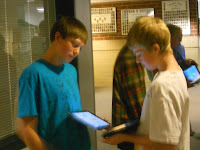
Students make 2 lines facing towards each other holding their iPads to show illustrations.  (I usually go out into the hallway to have adequate space) One line will stay still throughout the activity, the other line moves to the side one step every time the teacher says "Rotate". Here's the procedure:

  1. Teacher  yells "Line 1" and students in line 1 have 30 seconds for the students in line 1 to tell their partner their story in Spanish. (Communication & Collaboration)
  2. Teacher yells "line 2" and the partner now has 30 seconds to tell their story in Spanish. (Communication & Collaboration)
  3. Teacher yells "Move it!" and the moving line steps one position over except for the end person who must RUN all the way down to the other end of the line before the teacher yells "Line 1" again.




Building Background Knowledge using a Scavenger Hunt

Goal: To increase student background knowledge before beginning a new novel
Objective: Students will be able to make at least 3 connections between their world and Costa Rica
ISTE NETS: Shown below in green


What I needed:
We are about to begin a new novel.  We all know what a crucial role background knowledge plays in a student's ability to comprehend when reading.  An easy place to start is the setting of the reading.  Our book is set in Costa Rica.  I could very easily give a quick lecture on Costa Rica with a slide show to help the students picture it.  In fact, maybe I'll follow it up with a quiz over my lecture to make sure they were listening, right?  (Haven't we all done this?) There is a better way! 

What we did:
One of the quickest ways to increase background knowledge is with a scavenger hunt.  The students worked in their groups of three (communication & collaboration) to complete the scavenger hunt.  We used GoogleEarth and started at our high school and then "went" to Costa Rica.  They had to find out basic info such as, Capital City name, typical foods, at least one bird sanctuary--there's a bird sanctuary in our book, etc. (research & information fluency)  They also had to decide on 3 pictures that they felt best represented Costa Rica. (Critical Thinking, Problem Solving, & Decision Making)

What I gave to the "captains" of each group:

I-Pad Scavenger Hunt

Nombre:
Nombre:
Nombre:
Direcciones:
En su grupo busca:
1.)    en “google earth”, busca donde está el país de Costa Rica y que países están al lado de Costa Rica ________________________________________________________________
2.)    en “safari”, busca el capital de Costa Rica ________________________________________________________________
3.)    busca tres (3) fotos que mejor representan el país y su naturaleza ________________________________________________________________
4.)    encuentra (*find) un nombre de un “Bird Sanctuary” ________________________________________________________________
5.)    Da los nombres de la selva en Costa Rica (*Rainforest) ________________________________________________________________
6.)    Nombra las comidas típicas de Costa Rica ________________________________________________________________
7.)    Busca información sobre el “medio ambiente” (*environment) ________________________________________________________________

 
Comments I wish I had caught on video as my students were working:

  • "OH! I didn't know that Costa Rica was all the way down there."
  • "Hm, Mrs. Rivera, why are all the rooftops red in San Jose?" 
  • "Volcanos?  There are Volcanos in Costa Rica?"
  • How many different oceans does Costa Rica touch?  They must have a lot of beaches!"
You'll notice most of these quotes are questions!  Isn't it ALWAYS better to get more questions out of our students than just memorized answers?

Videos of what the class looked like: